Many neighborhoods make up Los Angeles County, a grand metropolis in South Central California, and some of them are quite famous (Beverly Hills, Hollywood, Malibu, Santa Monica). In Los Angeles, the landscape ranges from the sea to the hills, from skyscrapers to suburbs, from wealthy areas and areas inhabited by the middle class. We had been visiting the area for some days and we wanted to make sure we saw everything before we left. For this reason, after going to Beverly Hills we wanted to conclude our visit to the “Platinum Triangle” by exploring, as much as possible, Bel Air (and also pass through Holmby Hills, located on the other “side” of the Platinum Triangle). The name of our stop is definitely familiar and certainly not only to us. Besides, how many times have you heard about it?
We continued to drive in L.A. County in the area called Westside, at the foot of the Santa Monica Mountains, and we saw signs for Bel Air, which covers an area of 6.4 square miles. We entered one of the “upper class” areas par excellence, where the inhabitants – about 8,000 mostly white – live comfortably in splendid homes surrounded by pleasant green lawns (there are also small percentages of Asians, Latinos, and African-Americans).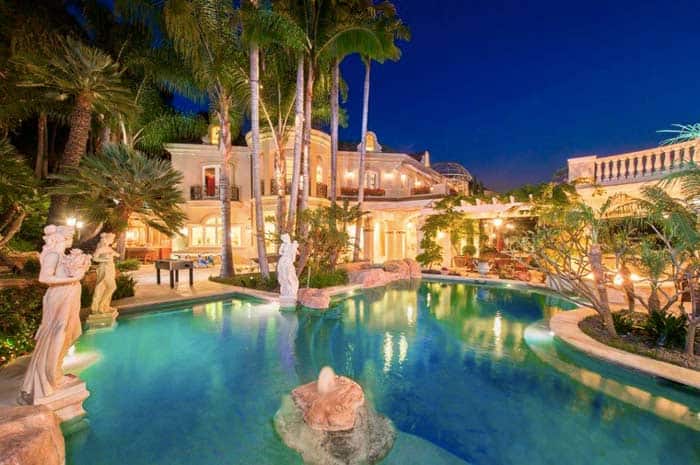
Bel Air is one of the many faces of Los Angeles County, and it is definitely worth visiting; it would appear to be a “quiet” place known worldwide for being the hill where very wealthy people, famous or distinguished, have decided to take up residence. We want to mention some of Bel Air’s residents who have left their mark in their field, who are not just “one-hit wonders”: Elizabeth Taylor, Cary Grant, Dean Martin, Henry Fonda, Gary Cooper, Tony Curtis, Ronald Reagan, Alfred Hitchock, the Olympian / “Tarzan” Johnny Weissmuller, as well as contemporaries, such as Clint Eastwood and Nicholas Cage. While years ago living in Bel Air, Beverly Hills, and Holmby Hills was a status symbol, now times have changed a bit, because there are more and more famous people who acquire fame and money quickly and many of them choose to live in other residential areas such as Brentwood, Hollywood Hills, Encino, Malibu, Santa Monica, Calabasas, and Pacific Palisades.
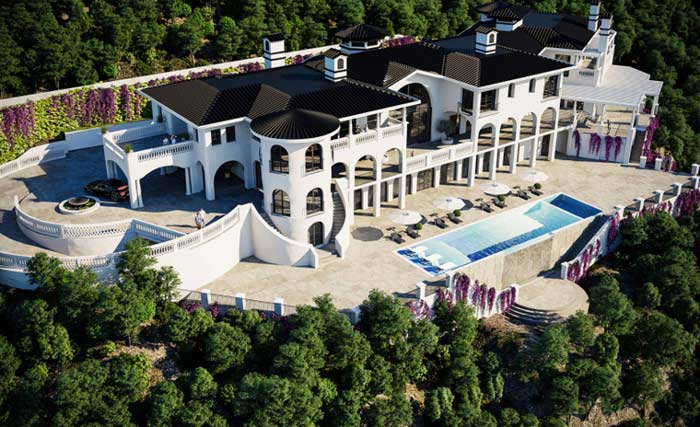
Bel Air: a Luxurious L.A. Neighborhood…
There are other places in the world that share similar characteristics, but the hill of Bel Air has something special that is alluring and fascinating. The million-dollar properties, luxurious residences of so-called VIPs. As a result, this draws many people who come on “pilgrimage” with organized or private tours. As always, a coin has two sides. Some residents, whose fame is not well-established, appreciate the fact that they are constantly being mentioned by the guides on board the minibuses riding around Bel Air, because this helps them to gain popularity; others, on the other hand, would gladly do without the flash of cameras and the curiosity of strangers.
Beyond the interest of knowing who this or that villa belongs to, the parks of Bel Air are really harmonious and beautiful. What is so striking about Bel Air is the architectural diversity of the buildings. For example, you go from a castle to a house built in the Romanesque style with colonnades, or to an extremely modern house.
Bel Air is a wealthy neighborhood where there are large villas, residences with outbuildings, swimming pools, tennis courts, and anything else you can imagine. It is a community where most residents live in luxury and enjoy wealth and incredibly high real estate values. In order to maintain a sense of uniformity in this area, there are restrictions on the height of the buildings. The residences on the hillside can be reached by walking along mostly narrow, winding but well-paved streets and paths with trees, palm trees, and many hedges. This is an exclusive neighborhood with few public places, some hotels and schools (4 public and 8 private), that is inhabited by people who live with a high or very high standard of living, who have the highest incomes in Los Angeles County. Of course, there are speed limits here as well and they vary between 15 and 30 mph.
… exclusive to say the least! The “gated” communities
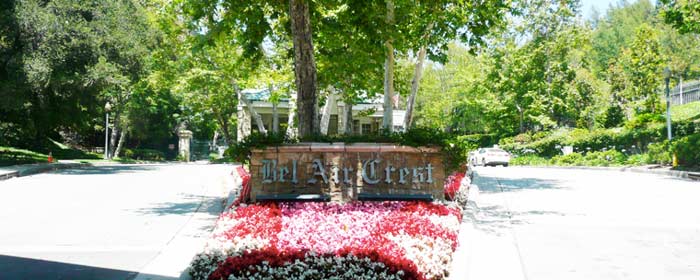 Some areas of Bel Air and of Beverly Hills, are gated. What sets them apart is the constant presence of security guards and that homes are surrounded by high gates, walls, hedges and protected by cameras and sophisticated alarm systems. Out of the four gated communities, the one that stands out is Bel Air Crest (12001 Bel Air Crest Rd), one of the most exclusive communities in the country that is kept under constant surveillance. Living in these impenetrable homes that are heavily guarded is rewarded by the location that allows you to enjoy beautiful views of the canyons and hills.
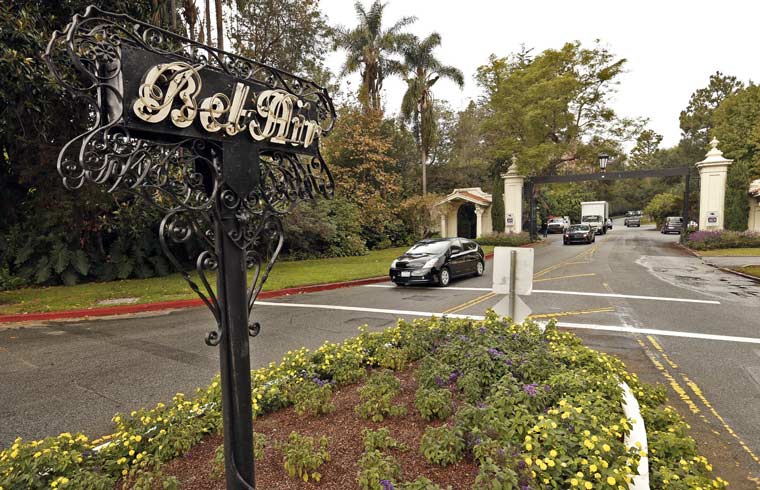
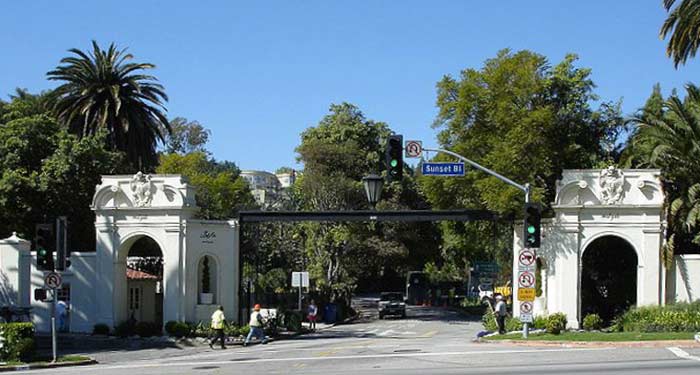
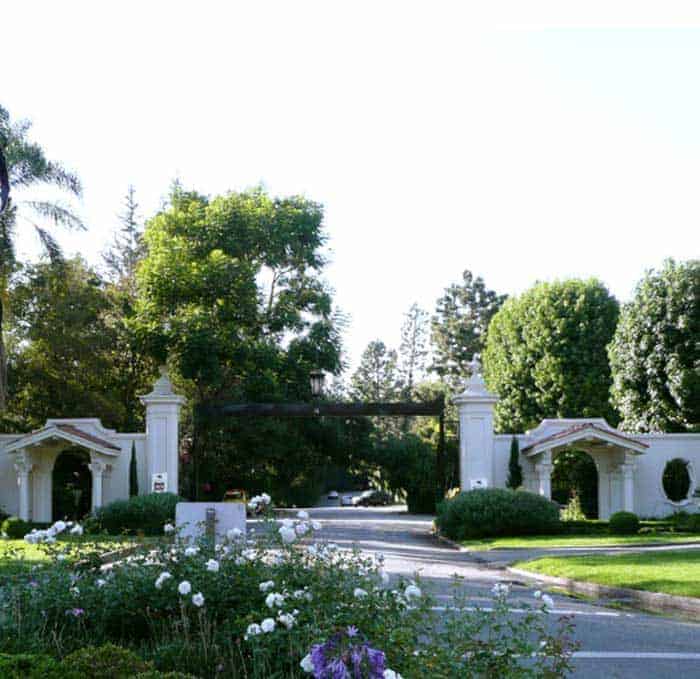
The other three gated communities are Beverly Park, The Summit, and Mulholland Estates. There are two gates along Sunset Boulevard with signs that say “Bel Air,” but the name could be misleading. In reality, they are just two free access points to the hill where Bel Air is located, one east and one west. They are not gates for the gated communities. In a nutshell, they are just two gates that allow you to “officially” enter the neighborhood.
What is the origin of Bel Air?
It was founded in 1923 by Alphonso Bell, the owner of a farm not too far away in Santa Fe Springs in southeast Los Angeles County, where oil was discovered. With the money he made, Mr. Bell decided to buy a large ranch and a house on what is now Bel Air Road. He then divided the property into large plots that over time remained and developed into a peaceful and serene residential area, until it became what Bel Air has been for years now.
How to Get around Bel Air
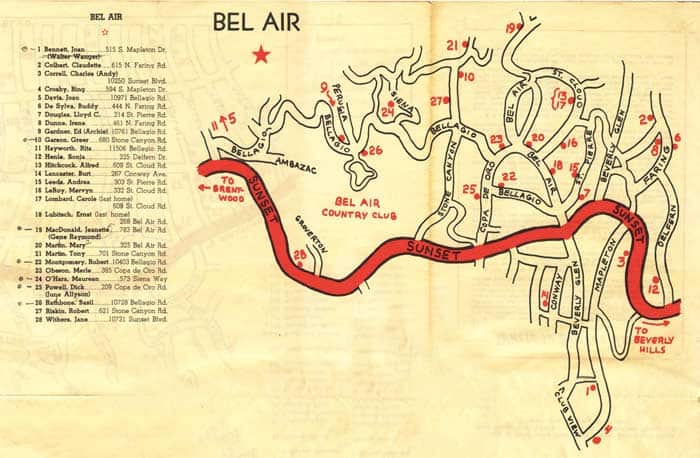
If you are coming from Beverly Hills, you can enter Bel Air via one of the roads that border it. You can access Bel Air from the south on Sunset Blvd, from the east on N. Beverly Glen Blvd, from the north on Mulholland Dr, and from the west on N. Sepulveda Blvd. On the corners of the streets leading to the “hill”, we happened to meet retirees who sell maps of the area, which are more or less official, with addresses and names of the owners of the houses. When we went, we bought a map for $5. No one prevented us from exploring, so we drove along the streets. Through the green lawns, trees, hedges, we could peek at the villas of Bel Air. Some are completely visible to those who drive by, while others are hidden or mostly hidden, so that you can only catch glimpses of them.
We moved at a slow pace, because we were “exploring”, not only because of the speed limits. We used our map, we glanced right and left, and we took a look at the yards and the entrances of the VIP villas in Los Angeles to see if someone was going out or coming home in a car driven by a driver or if a limousine was passing with wealthy businessmen or stars. In fact, we did see a long white limousine, but we’ll never know who was inside, since it had tinted windows.
 We tried to imagine what happens behind the gates, the high hedges, the walls, and the gardens of this world that appears ephemeral, even if in reality it is a world made of people who work. Yes, that may be true, but in our opinion, movie stars, pop stars, and sports stars are overpaid! Are they making a movie? Is there a party going on? Is the butler washing the car? We didn’t know, but the part of this reality that we were not able to see surely has luxury, glitz, well-being, and is in a “golden” context that is also typical of other neighborhoods of the Greater Los Angeles Area. The brands of the boutiques of Rodeo Drive, which have price tags with a long line of zeros, are shown off on every social occasion, such as parties, weddings, charity galas, award ceremonies, but also in everyday life.
Things to Do in Bel Air: Villas, Clubs, and Gardens
Along Bellagio Road, the road that practically divides Bel Air, on the west side, there are more economically priced homes (so to speak, with properties from $1.5 to $5.5 million) and on the east side, the homes are more expensive (from $ 6 to over $20 million). You will see the sign of the Bel Air Country Club, located at 10768 Bellagio Road, which is not accessible to the public. The members of this exclusive club have the opportunity to hang out and participate in activities, as well as relax in this quiet atmosphere, play tennis or golf, and enjoy the cuisine of the restaurant active since 1925. Country Club members are encouraged to follow a dress code. To find out more, please visit this site. Parties and weddings are also organized here.
The Hannah Carter Japanese Garden (10920 Wilshire Blvd.), which used to be open to the public, is a large Japanese garden inspired by the garden in Kyoto. Unfortunately, the park is now closed and its future is uncertain. The locals hope that a solution will be found to reopen it, because it was once one of the finest examples of Japanese gardens in the United States and it would be a shame to lose it.
The Fresh Prince of Bel Air home… or maybe not!
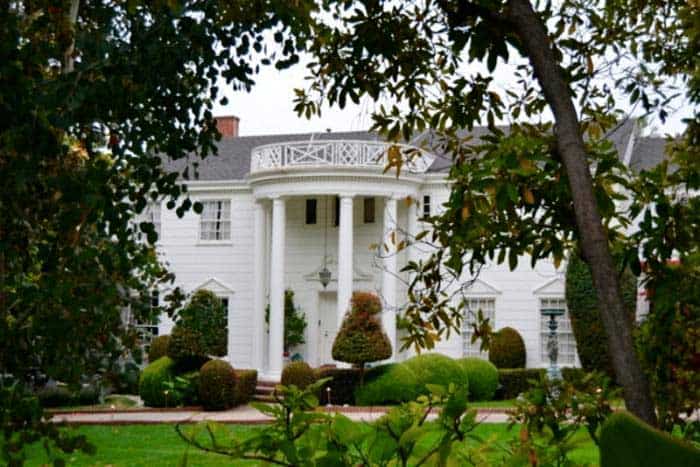 At a certain point, we had to ask for help, because we had been going around in circles for a few minutes. We thought 251 North Bristol Avenue was in Bel Air. We remembered the outside of the house of the successful television series The Fresh Prince of Bel Air, which was the debut of Will Smith (an actor who is now also director and producer in Hollywood). We were trying to find the villa from the tv series… to no avail! We were told that the building is actually located in Brentwood, a neighborhood nearby. This confirmed that the world of television and of cinema take the liberty of showing us certain images and passing them off as locations in a certain context when in reality they are somewhere completely different! Just for the record, Will Smith and his family do not live in Bel Air, but in Calabasas, north of Santa Monica and Malibu.
The Bel Air Film Festival
The Bel Air Film Festival (BAFF) is a film festival throughout Los Angeles that has been held annually since 2008 to promote appreciation and knowledge of the art of film. The festival lasts three days and it attracts thousands of participants; it is appreciated by the local Los Angeles community because of the benefits it brings. Every year the event is celebrated by many filmmakers from all over the world and opens with a “red carpet” evening followed by screenings, festivities, meetings, and debates. There is also a section dedicated to young talent. The first opening gala took place on a private estate in Bel-Air.
Venues that have joined the initiative over the years include the William Morris Endeavor Theatre, the Soho House West Hollywood, the Hammer Museum, the Skirball Cultural Center, the Palihouse, the Saban Theatre, other private Bel Air estates, as well as the UCLA and USC campuses. The events are held in the grassy areas of outdoor venues. There are tables set up and people can bring their blankets from home. Tickets cost $5 per movie and $10 if you buy a pass for all movies. Admission is free for children under 10 years of age. The ticket includes a drink and popcorn, but people are also allowed to bring their own snacks.
The Last Stop in the Platinum Triangle, Holmby Hills
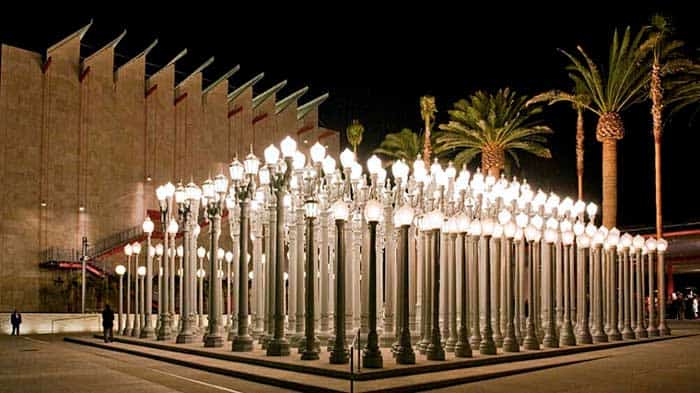 As we mentioned above, to complete the visit to the Platinum Triangle, we passed through Holmby Hills, which is not as well-known as the other two locations, but it is certainly worth mentioning. The neighborhood is located in West Los Angeles, near the renowned University of California, Los Angeles (UCLA). Here, too, you’ll find villas where famous people like Walt Disney and Barbara Streisand once lived (to name but a couple). There are also Holmby Park (601Club View Dr.) and De Nuevo Square Park (314 N. Beverly Glen Blvd.). Art lovers can visit the Frederick R. Weisman Art Foundation (265 N. Carolwood Dr.), an institution that aims to preserve and give the public access to an extraordinary collection of over 400 works of art including masterpieces by Cezanne, Picasso, Kandinsky, and surrealist works by Ernst, Mirò, Magritte, along with creations by Warhol and Giacometti ([email protected]). Holmby Hills is also known for its unique streetlights that set it apart from other Los Angeles neighborhoods.
Bel Air Home Tour
 For those who want to discover the excesses and beauty of Bel Air, Beverly Hills, and Hollywood on a guided tour, we suggest this two-hour tour along the exclusive streets where American movie stars live. The guide will take you to discover the villas of American celebrities and the posh places where they love to spend their free time, such as shops, boutiques, clubs, restaurants, and hotels.
More information about the tour
If you prefer a personalized tour of Bel Air and/or the Greater Los Angeles Area, we recommend Glitterati Tours (8029 W. Norton – W. Hollywood). This company takes visitors on tours in SUVs or great minivans, but most importantly, it organizes private tours that can be freely customized according to the points of interest their customers want to visit, whether it be Hollywood and the movie world, Beverly Hills celebrities or historical landmarks, arts, and culture, or simply the natural beauty along the coast. The staff is available to make suggestions so that customers are satisfied and have the best tour experience. This is one of the highest-rated companies in the Greater Los Angeles Area and the first choice of most concierges of hotels in the area.
Best Restaurants in Bel Air
There are few restaurants and hotels but it goes without saying that they are all excellent.
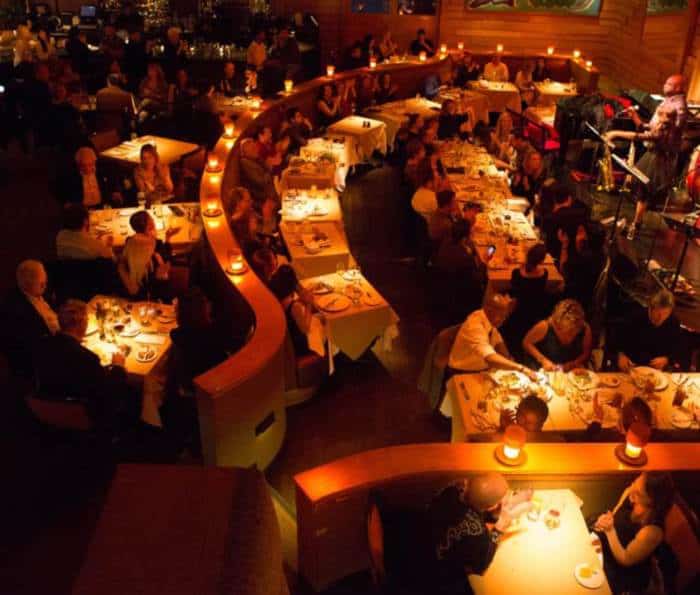
 For a combination of music and contemporary American cuisine, we suggest Herb Alpert’s Vibrato Grill & Jazz (2930 Beverly Glen Circle), a theater where you can dine while “savoring” good music. The venue is home to some of the most talented musicians in the world. This “restaurant-theater” requires customers to dress elegantly, or rather, to abide by what is known as Los Angeles smart casual. The restaurant also has a bar where you can listen to music without having to dine.
- For a blend of international flavors and seasonal ingredients, go to The Bel Air (662 N. Sepulveda Blvd.), a medium-high price restaurant that has both a bar and restaurant.
- SHU-Sushi House Unico (2932 Beverly Glen Circle) serves a fusion of Japanese and Italian cuisine and more at an average cost. Here you can taste sushi, rolls, salads, soups, and ceviche (a typical South American dish).
Where to Stay in Bel Air
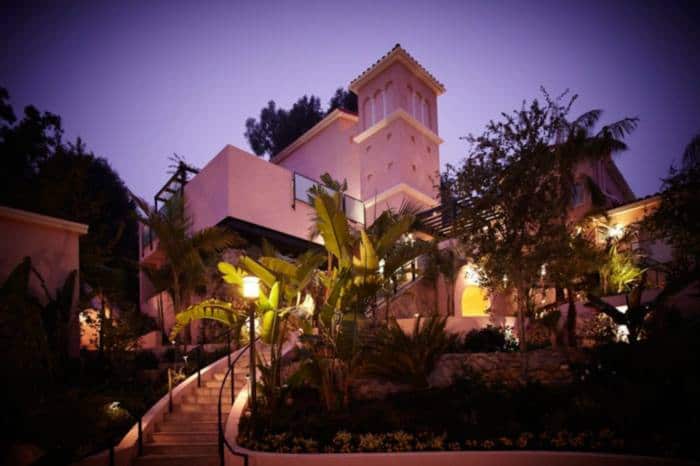 Speaking of accommodations, the pride and joy of the neighborhood is the Bel Air Hotel (701 State Canyon Rd.), which is surrounded by a garden. This luxury hotel also attracts famous celebrities. The rooms and suites are spacious, contemporary, and elegantly decorated. The hotel has a spa, a pool, a bar, a boutique, and Wolfgang Puck, a restaurant that combines modern Californian cuisine with European influences. You can eat in either the restaurant or in the garden. Transportation in a luxury car within a 3-mile radius is included in the price and is available daily from 9:00 am to 9:00 pm.
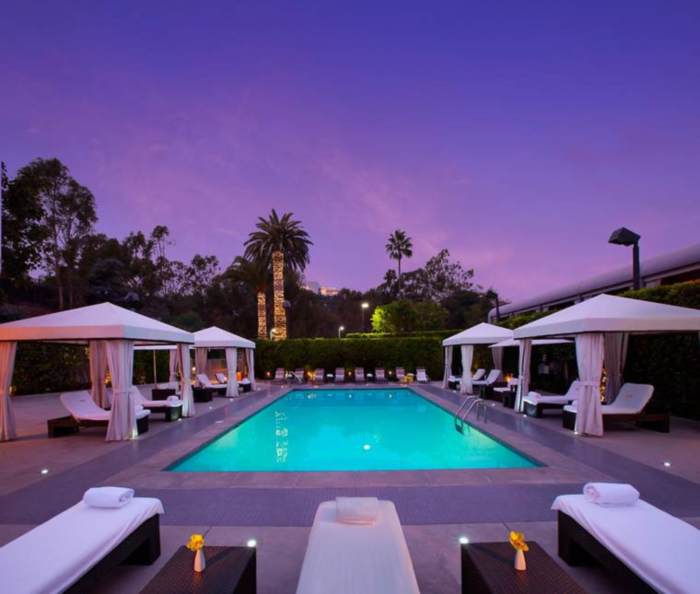 The Luxe Sunset Boulevard (11461 Sunset Blvd – at the intersection of Brentwood and Bel Air) is a chic boutique hotel with beautiful outdoor areas where you can relax, and spacious rooms and suites with warm tones and harmonious colors. The hotel has an outdoor pool, a lounge, and a restaurant.
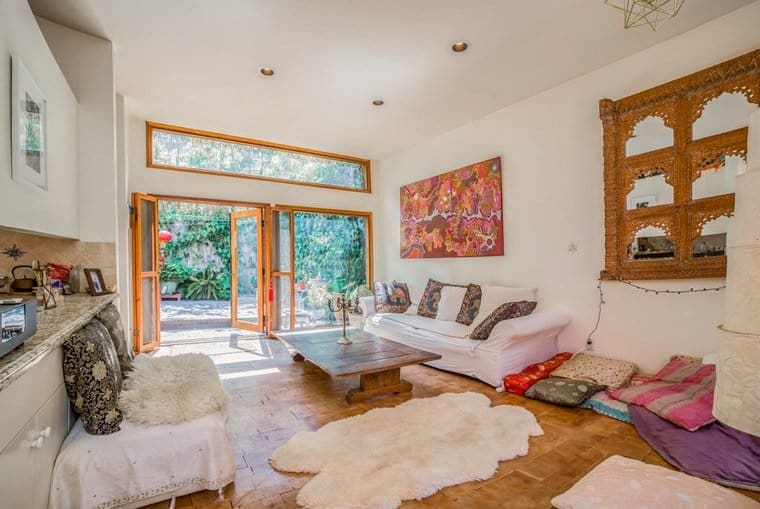 If you are looking for a place to be more in tune with nature, go to The Bel Air Treehouse (795 N. Beverly Glen Blvd ), a bed and breakfast located 5 minutes from the famous University of California, Los Angeles (UCLA). Each room has its own style, anything ranging from a French atmosphere to a Victorian style, from late modernism to a tropical-Japanese mix. Guests at the B&B have access to a mini kitchen and a coffee machine. It is also pet-friendly and guests can take yoga classes here.
Click on the link below to take a look at all the other hotels available in and around Bel Air. If you want to stay elsewhere in the city, our article on where to stay in Los Angeles might be useful.
Find accommodations in Bel Air
How to Get to Bel Air
To reach Bel Air we recommend, the Los Angeles International Airport (1 World Way), which is half an hour away. If you plan to stay in the city, take a rental car. This is the best way to get around Los Angeles. In our opinion, one day is enough to visit Bel Air, so you can combine the visit with other excursions. 18 minutes away from Bel Air you will find Beverly Hills, a “close relative” of Bel Air, and Santa Monica, where you can visit its famous pier and beautiful beach. Meanwhile, 24 minutes from Bel Air, you can explore Hollywood and then Venice, an eccentric city with channels, and 25 minutes away, you can visit the television, cinema, and production companies in Burbank. In Long Beach, which is 37 minutes away, there is the transatlantic liner Queen Mary, which is now a hotel, but it is still possible to visit it. Finally, Anaheim is 50 minutes away, where you can go to the fantastic kingdom of Disneyland.