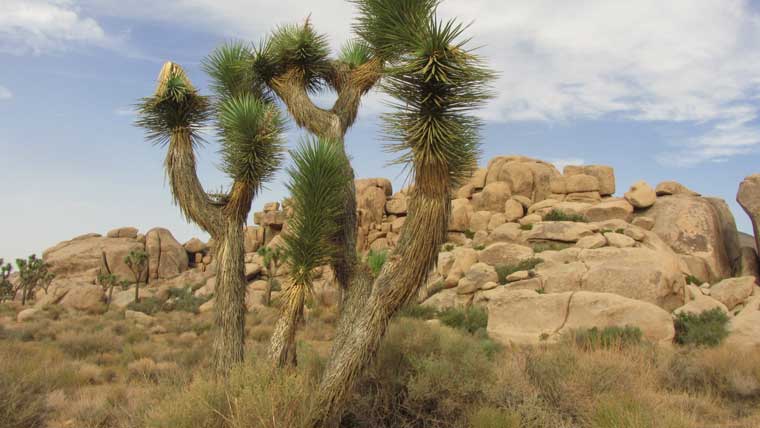
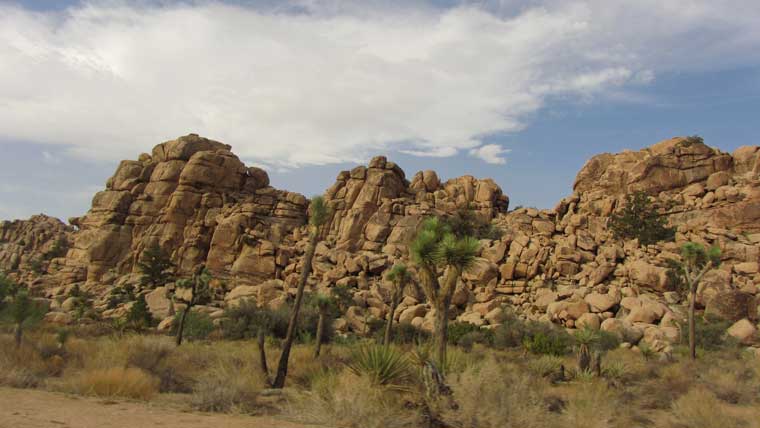
Among the many incredible US national parks, the desert landscape of Joshua Tree National Park has its own unique, almost surreal charm, with its cactus-like trees and their twisted and bizarre shapes (Yucca) and the rock piles on the ground that resemble tombstones.
At dawn, the landscape is haunting when is flooded with a flickering red light, and at night you can gaze at a beautiful star-covered sky that you will probably remember for the rest of your life. In Joshua Tree National Park you’ll feel as if you’re at the edge of the world or even on another planet. We’ll show you some tips on how to visit and enjoy one of the most fascinating parks in California.
The park is located at the point where two deserts meet, the Colorado Desert and the Mojave Desert and the name was coined by a group of Mormons in 1850 who thought twisted branches of the Yuccas looked like Joshua’s arms pointing to the promised land. The entire area is about 1235 square miles and is recommended particularly for those who love hiking, observing flora and wildlife and rock climbing.
In the most classic California road trips, people often stop in Joshua Tree for a day and visit it mainly by car, taking a beautiful scenic drive. In this article, we will also explore in detail this way of visiting Joshua Tree.
Driving through the Scenic Drive in Joshua Tree
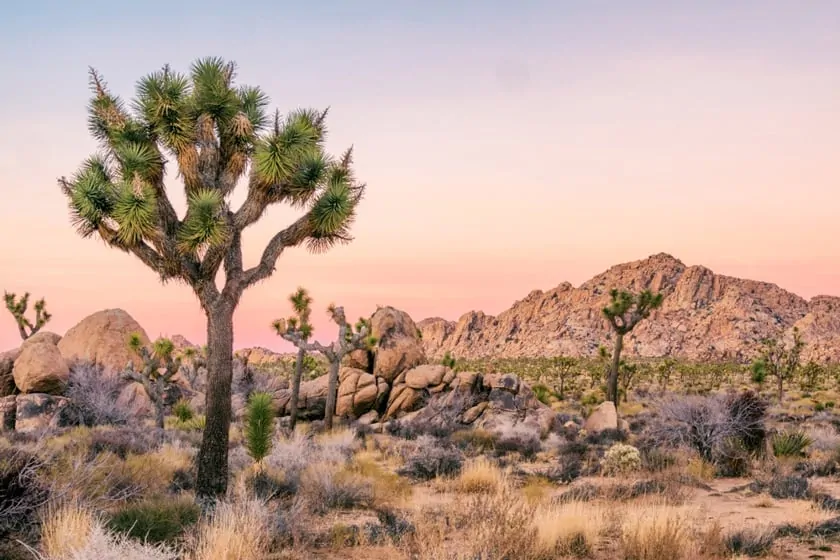 Unless you’re an enthusiastic hiker or fearless climber, I highly encourage you to explore the park in your rental car, stopping at certain viewpoints to admire the landscape.
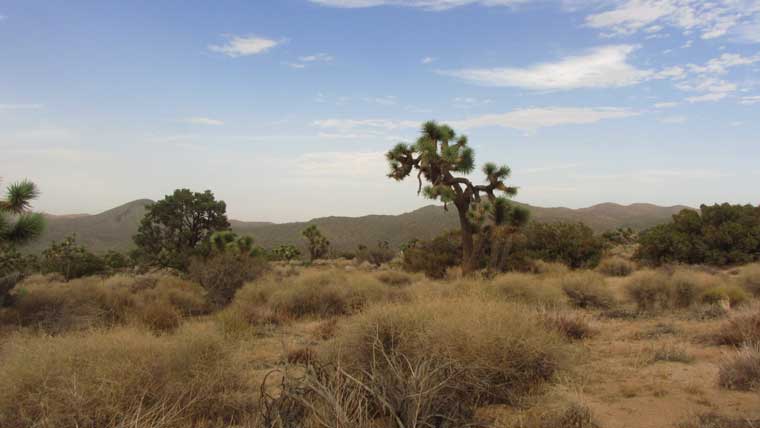
- First of all, it is a beautiful experience, to drive through the enchanting Joshua trees and the rocky piles that characterize the park.
- Unlike other more adventurous ways to visit Joshua Tree, which require some preliminary preparation, visiting Joshua Tree by car is a rather simple operation, just get in the car, follow the road (in most cases paved and in excellent condition), and take a look at the map from time to time (pick it up at the visitor center).
- In 3-4 hours you can walk along the main streets of the park and get an idea of the area.
Even if you just go for a drive around the national park, to really enjoy some of its wonders, you’ll still have to go on a few short hikes. They’re not that challenging. In most cases, they are short walks starting from the parking lot (in the description below you’ll also find details of distances). Of course, there are also more challenging hikes in Joshua Tree, that allow you to enjoy some beautiful places not accessible by car. In this article, though, we will only cover the attractions that are easier to reach.
Important Instructions
In both cases, however, it will be good to keep two things in mind when making preparations:
Do you have enough water?
 Remember, you’re in the desert in California, so if you visit the park in the summer, take a substantial supply of water with you (the official guide recommends drinking a gallon of water a day during the summer heat). These are the few places where you can buy water:
- Oasis Visitor Center in Twentynine Palms
- West Entrance Station
- Black Rock Campground
- Cottonwood Campground
- Indian Cove Ranger Station
Are there any dangerous animals? Yes, there are
I don’t want to frighten you, but before you enter Joshua Tree, you must be aware of its dangers. There are some poisonous animals that live in Joshua Tree, including rattlesnakes, scorpions and black widow spiders. When hiking, always watch your step and also pay close attention to bees, which can attack and sting you if they perceive a threat to their hive.
When planning, I recommend that you take a look at the safety tips on Joshua Tree’s official website.
What to do in Joshua Tree National Park: Driving Tour Itinerary
Here is a list of things to see (viewpoints and more) along the way, also shown below on the interactive map:
Keys View
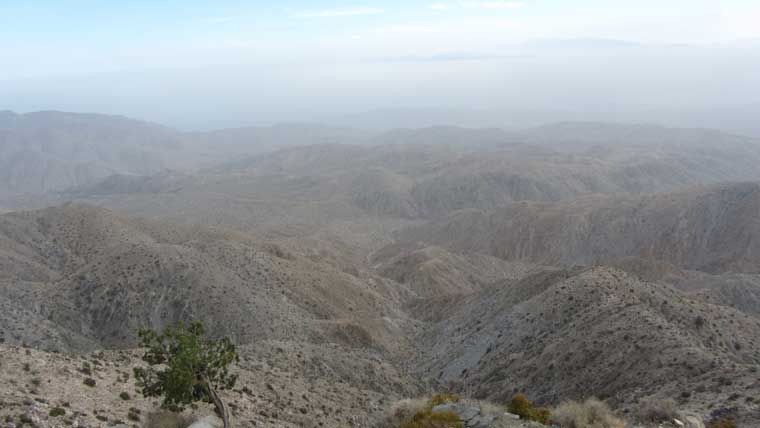
It is one of the most popular destinations in the park, a belvedere perched on the crest of the San Bernardino Hills, with a panoramic view of the entire Coachella Valley. From here you can see the brilliant surface of theSalton Sea, the Santa Rosa Mountains and the summit of the San Gorgonio Mountain, which is usually covered by snow. Getting to the top is easy, it’s just a short walk from the parking lot.
Coordinates to enter in the GPS: 33.927151, -116.187438 (33° 55′ 37.74″N 116° 11′ 14.77″W).
Here begins the scenic Geology Tour Road, which crosses the most fascinating rock formations of Joshua Tree, up to the Cholla Cactus Garden, a beautiful and surprising expanse of cacti of all types; however, you must be careful because, even simply touching them, you could prick your finger.
Skull Rock
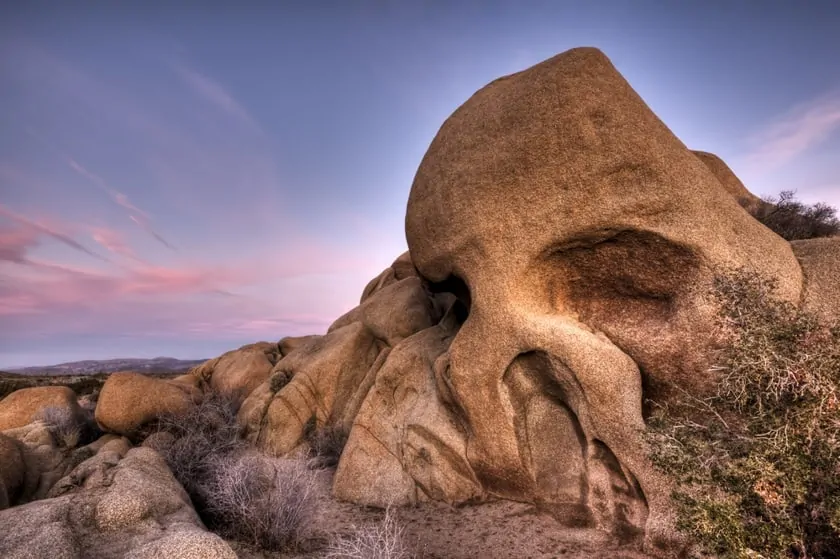 An intriguing skull-shaped rock to which every good tourist comes to pay homage. It is very easy to spot, since it is right next to the road. To get there, you walk down, walk a little further to see it up close and, if you feel like taking a short walk, you can do the Skull Rock Nature Trail, a 1.7-mile loop that is easy for anyone and is open from October to April. On the same side of the road, a short distance away, you’ll find the Jumbo Rocks Campground.
Coordinates to enter in the GPS: 33.997922,-116.059891.
Hidden Valley
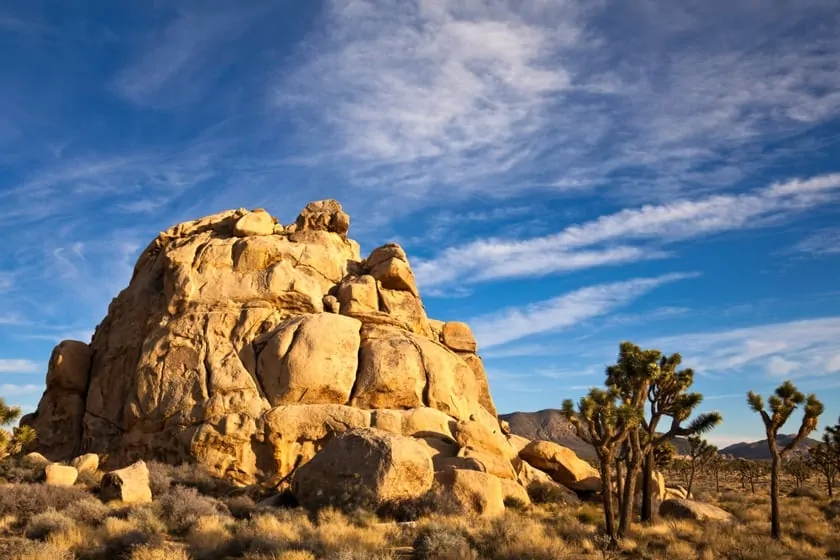 Naturalist Peggy Larson called this place the Mosaic of Miniature Worlds, an expression you’ll find also mentioned at the beginning of the short trail. To understand what Mrs. Larson meant, you have to walk the whole hike (less than 2 miles long).
The trail will lead you along a narrow passage bordered by 2 gigantic rock walls until you reach an open valley surrounded by amazing rock formations. You will feel as if you are in front of a large desert and the surrounding hills will look like big mountains. That this the meaning of the name the mosaic of the miniature worlds of the Hidden Valley.
The trailhead is about a 15-minute drive from the visitor center at the West Entrance. Keep driving on Park Road and then simply enter the large, well-marked parking lot in Hidden Valley, which also serves as a rest stop with various picnic tables. If you miss the sign, don’t worry, the look for the large rock pile called Intersection Rock.
Coordinates to be entered in the GPS: 34.012743, -116.168729.
Cholla Cactus Garden
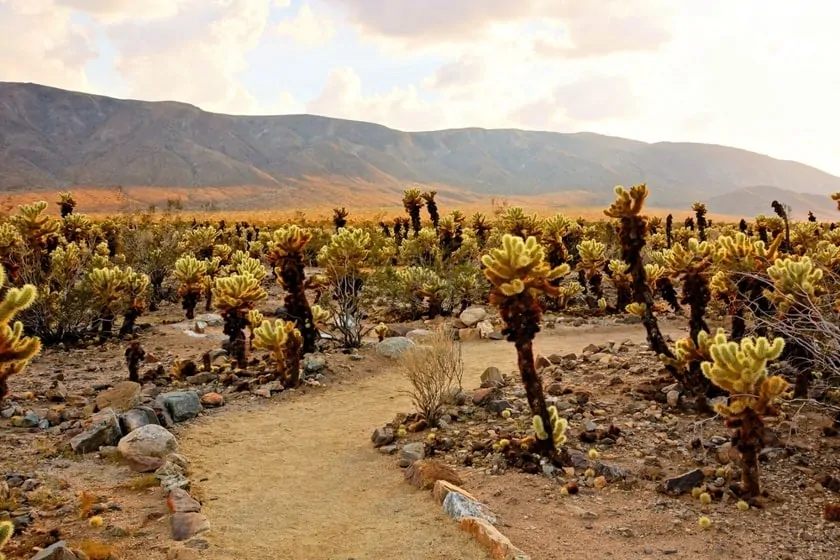 If you want to get a closer look at this amazing expanse of unique cacti and don’t want to take the above-mentioned route from Keys View, you can also take a more direct route. This is the main attraction along Pinto Basin Road heading towards Cottonwood Springs. From Park Boulevard take Pinto Basin Road and drive for about 12 miles. The Cholla Cactus Garden is located on the side of the road. Being careful not to touch the cactus needles (as it was mentioned above), you can walk along the path, which is just over 1300 ft long.
Coordinates to insert in the GPS: 33.925302, -115.928777 (33° 55′ 31.08″N 115° 55′ 43.59″W).
Arch Rock
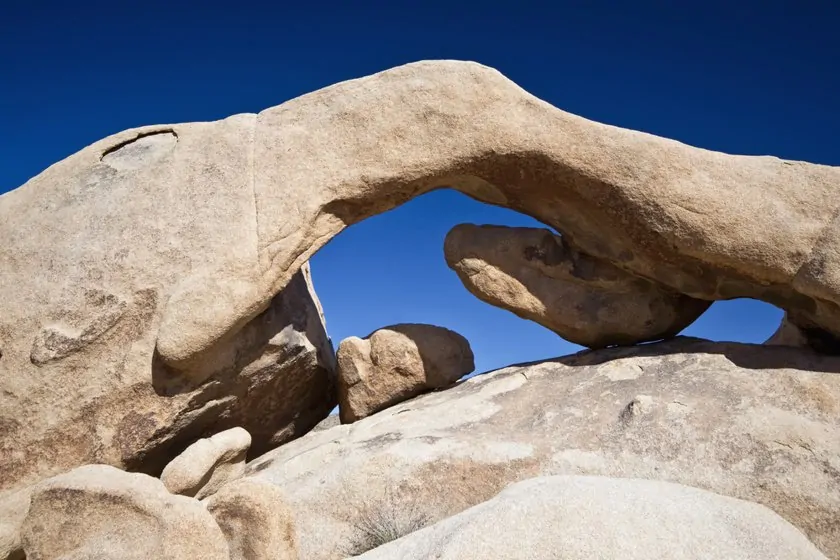 It may not be as famous as Arches National Park, but Joshua Tree also has its own Arch Rock, a rock formation with very peculiar features on which you must climb to take a picture. To get there, take Pinto Basin Road and park at White Tank Campground (well signposted on the road). From there you just need to walk for a few minutes to get to the strange rock.
Coordinates to be entered in the GPS: 33.985241, -116.016487 (33° 59′ 06.86″N 116° 00′ 59.35″W).
Barker Dam Trail
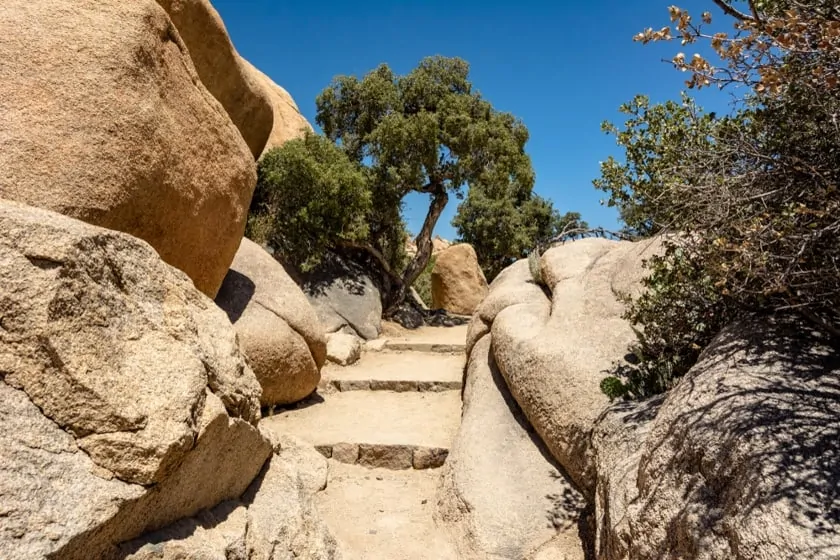 Drive on Barker Dam Road until you reach the parking lot with the same name. There are two well-marked trails, make sure you take the one towards Barker Dam (northwest), the other will take you to Wall Street Mill, the conservation site of an old abandoned mill (and there’s more to explore, if you have time left, drop in!).
You will walk among tall mounds of boulders and then unexpectedly arrive at a small blue lake. The contrast with the surrounding landscape is certainly striking, but during the dry season, you may find the lake drained.
Coordinates to be entered in GPS: 34.024896, -116.142061 (34° 01′ 51.09″N 116° 08′ 47.02″W).
Joshua Tree National Park Oases
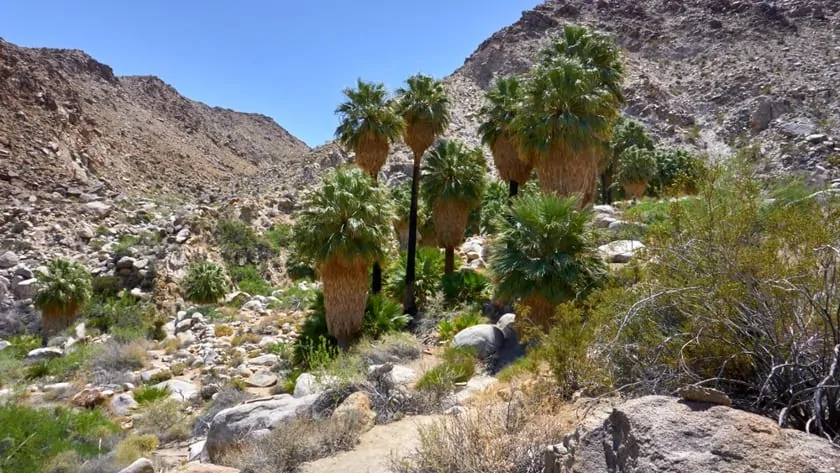 Like any good desert, no matter how bizarre, Joshua Tree can boast its own oases. We mention two of them here:
- Fortynine Palms Oasis: An oasis accessible by a 3-mile trail on the north side of the park.
- Lost Palms Oasis: An oasis nestled in the mountains in the southeast section of the park that can be reached by going on a hike that is over 7 miles long.
What to do near Joshua Tree National Park
Joshua Tree is located in an area of California that offers many points of interest, I suggest 5 things to see nearby:
Palm Springs
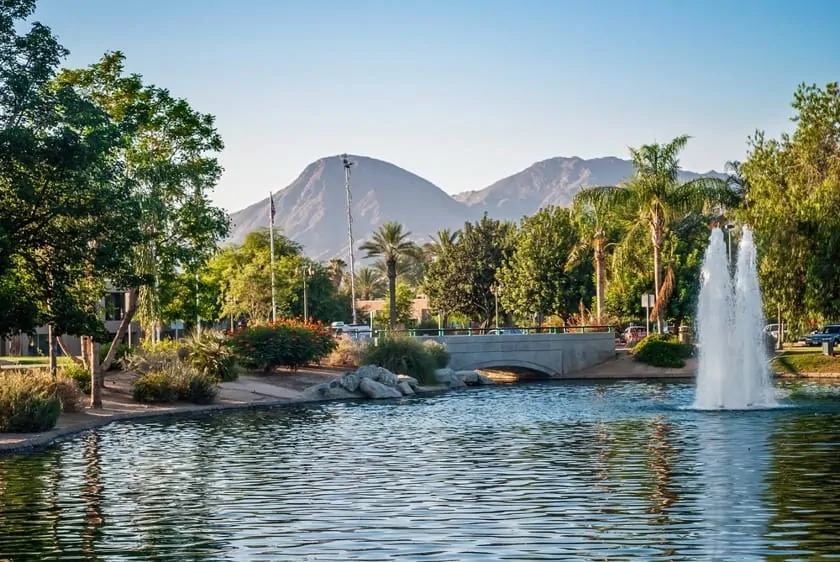 The most fascinating city to visit near the park (3/4 of an hour away by car), as well as the place where I suggest you look for accommodations (and this page you will find many on offer).
We talked a lot about it in our Palm Springs in-depth study.
Pioneertown
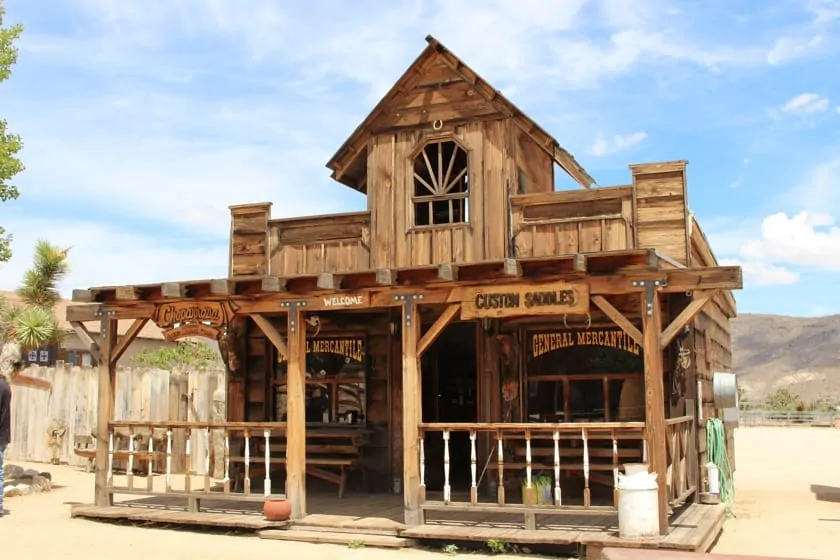 Back in 1946, a group of Hollywood investors founded the unlikely town of Pioneertown with the intention of recreating an Old West style movie set.
Despite the fire in 2006, many of the buildings in this bizarre experiment remain preserved and contribute to a distinctive landscape that blends in very well with the mountains in the background.
San Andreas Fault
You may be interested to see at least a part of the immense Earth’s crust that according to the direst predictions will one day devastate the entire state of California. We will write soon an article about visiting the San Andreas Fault.
Indian Canyons

Near Palm Springs you will find this beautiful desert park within the Agua Caliente Indian reserve. The main feature of Indian Canyons is the presence of American palm trees shading the trails. For more information, read our article “Indian Canyons Hiking Trails“.
Christ Park Desert
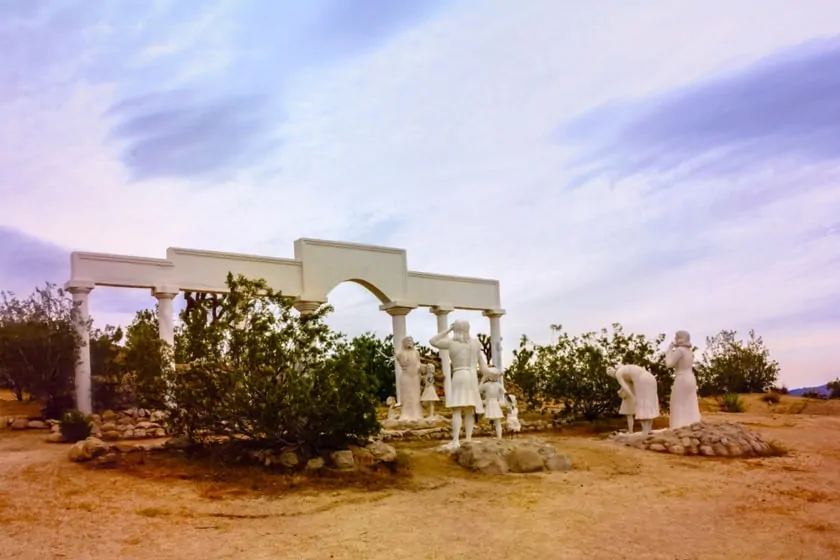 Rather than call it a real attraction, it would be more correct to classify it as one of those tacky curiosities that you often find during a road trip in America.
This place not only attracts those who are curious but also many Christians, because it could be considered a real Christian theme park. It is here, in the 50s, that the Reverend Eddie Garver began to form a collection of statues with a Christological theme. Today there are more than 50 statues scattered around this park.
Where to stay in Joshua Tree and Near the Park
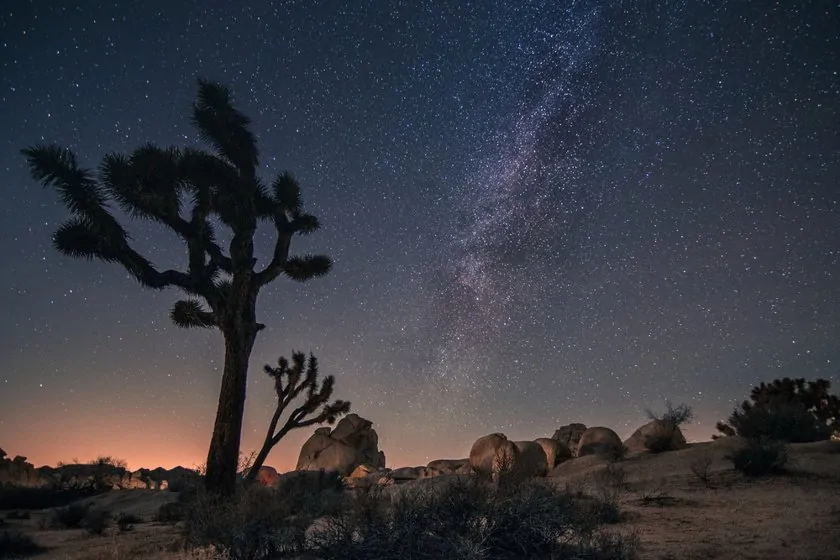 Inside Joshua Tree there are no hotels and the only option is to camp, but you must read carefully the restrictions of the park about it. If you are looking for traditional accommodations, you have 2 choices:
- Look for lodgings in Palm Springs (45 minutes away), which I recommend because it is worth visiting. In this case, take a look at these 2 links:
- Our in-depth guide of Palm Springs, including advice on finding accommodations
- This link for the search of cheap hotels in Palm Springs
- Find accommodations near Joshua Tree, just outside the national park. If you choose this option, I advise you to search on the page marked below:
- Look for hotels near Joshua Tree National Park on this page.